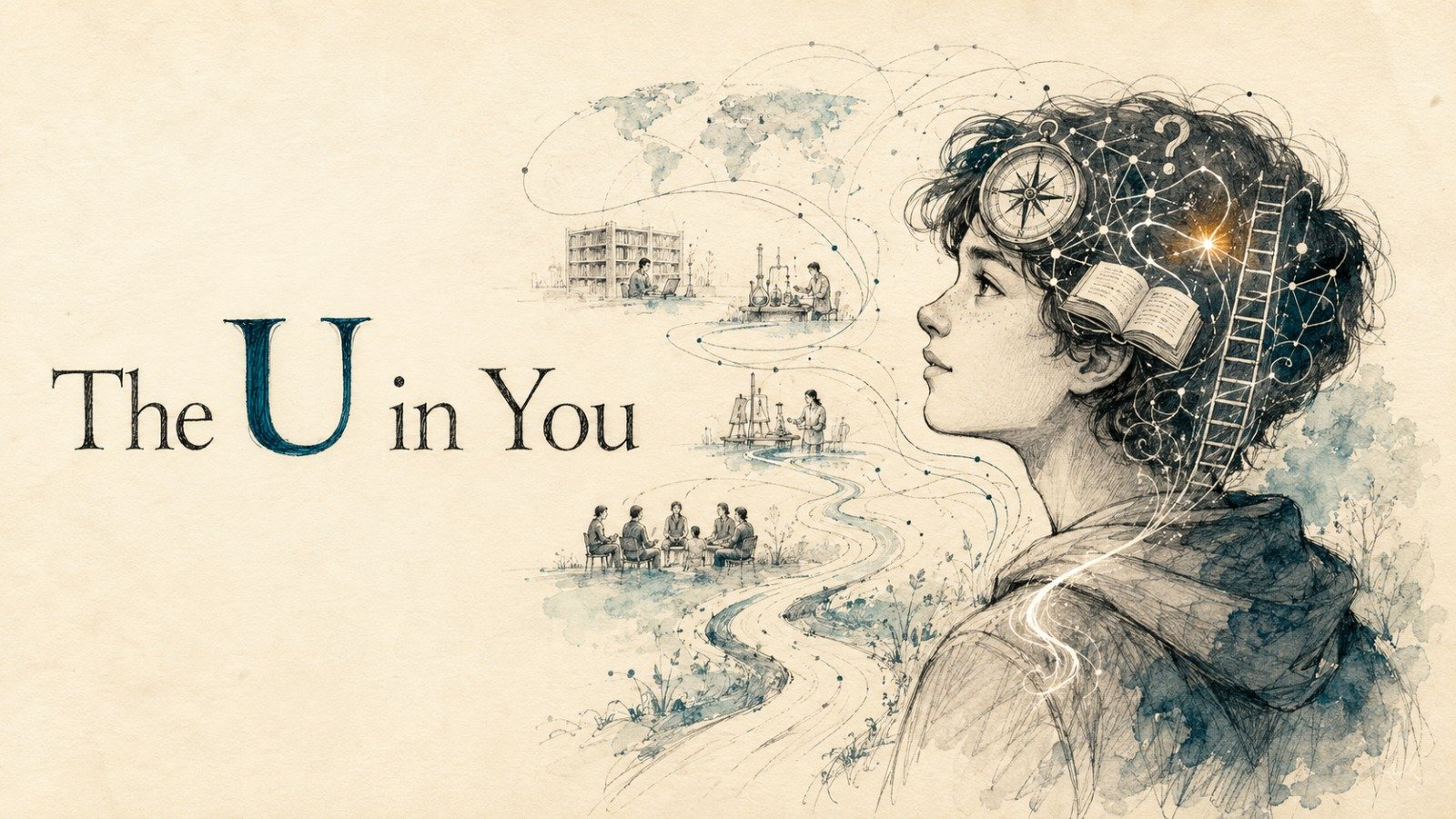
The U in "You"
Your child does not need a longer list.
They need a direction that belongs to them.
Dr (Hon) Sukanya Pal and her team guide students through a rigorous journey of self-discovery, intellectual development, portfolio coherence and global university fit — so that the eventual application reveals a life understood, not a brand manufactured.
 Direction
Curiosity
Knowledge
Growth
Direction
Curiosity
Knowledge
Growth
The starting question
The application is not the beginning.
Most families arrive at college counselling through visible pressure: subjects must be chosen, activities appear too scattered, a university list feels either too ambitious or too safe, and deadlines begin to compress years of a young person's life into forms and essays. Parents ask whether the profile is strong enough. Students ask what universities want. Both questions are understandable. Neither is the right first question.
The right first question is: who is this learner becoming?
When that question is postponed, students begin to collect activities without connection, borrow ready-made ideas, outsource thinking to AI, fear being wrong, treat scores as identity and compare themselves with people whose journeys have little to do with their own. A polished application can conceal that confusion for a while. University cannot.
This is why our counselling begins beneath the application. We identify the learner's patterns of curiosity, confidence, reasoning, response to feedback, values, motivations and ways of constructing knowledge — then help those patterns mature through inquiry, reading, reflection, disciplined action and meaningful contribution. Only after that do courses, countries and colleges become intelligent choices.
Universities see the tip
We counsel the system beneath it.
A portfolio shows subjects, projects, competitions and awards — the visible tip of an iceberg. Beneath it sit the structures that determine whether that portfolio becomes coherent or collapses into performance.
What's visible
A low score, a competition result, a project launch, a leadership role, a missed deadline, a successful prototype.
What repeats
Avoidance before difficult tasks, a recurring attraction to a certain kind of problem, dependence on external approval, a growing ability to recover from failure.
What produces the pattern
Routines, access, feedback systems, mentor relationships, time allocation, team dynamics and the design of the learning environment.
What the learner believes
"I am only good at subjects that feel easy." "Leadership means being in charge." "Impact means scale." "Asking for help proves I am not capable."
A portfolio built only at event level produces isolated entries. A portfolio developed through the iceberg changes the conditions that produce the entries — so one project becomes a foundation for the next, rather than another disconnected line.
How depth is built
From spark to spike to significance.
The question that returns
The question, tension or possibility a learner keeps coming back to, noticed without being romanticised.
Unusual depth
The depth a learner builds around the spark — developed through sustained work, not manufactured for effect.
Responsible use
What happens when depth is used through research, design, analysis, enterprise, advocacy, education or creative work.
The programme
Top College Counsellor
A developmental college-counselling programme, not an application-season intervention. It begins with the learner's internal architecture and moves outward toward a global university strategy.
The Explorer
Moving beneath quick answers to notice interests, strengths, uncertainties and habits — exploratory, not prematurely vocational.
The Cartographer of Curiosity
Mapping relationships among recurring interests, so the student doesn't choose a label before understanding the forces beneath it.
The Navigator of Purpose
Testing possible directions through sustained disciplinary work, treating purpose as an informed relationship, not a slogan.
The Architect of Depth
Developing a coherent spike: framing a question, acquiring method, seeking feedback, producing an original output.
The Global Applicant
Development translated into country, course and university strategy — list, activity record and essays built from lived evidence.
One learner. Many possible worlds.
Country strategy begins after fit is understood — not before.
We do not carry one generic profile across destinations and change the spelling. We preserve the same learner while translating their evidence for different admissions cultures.
For more than twenty-two years, Dr Sukanya Pal has worked where curriculum, psychology, epistemology, metacognition and learner development meet. As an IB and Cambridge educator, teacher trainer, curriculum analyst and college counsellor, she has seen how students are often asked to perform achievement before they have understood the learner producing it.
Mindgle develops the capacity to inquire and construct knowledge. My Learning Ladder, her brainchild, makes growth in confidence, agency, reflection and learning behaviour visible. College counselling then converts that deeper self-understanding into informed academic, career and university choices — not services attached to the end of schooling, but an architecture through which a learner becomes ready to choose.
Success is not only an admission. It is an informed becoming.What success means here
Final invitation
The path becomes clearer when the learner becomes visible.
Do not begin with "Where can my child get in?" Begin with "Who is my child becoming — and where can that learner do their best work?"